Elias 2-24 b — The Youngest Known Planet
A world less than a million years old, still buried in the disk of gas and dust it is forming from, about 450 light-years away in Ophiuchus. Confirmed on 16 September 2026 from archived W. M. Keck Observatory images — and now the youngest exoplanet known.
By the WatchSat team · Published September 16, 2026 · Sources: NASA Science, The Astrophysical Journal Letters, W. M. Keck Observatory
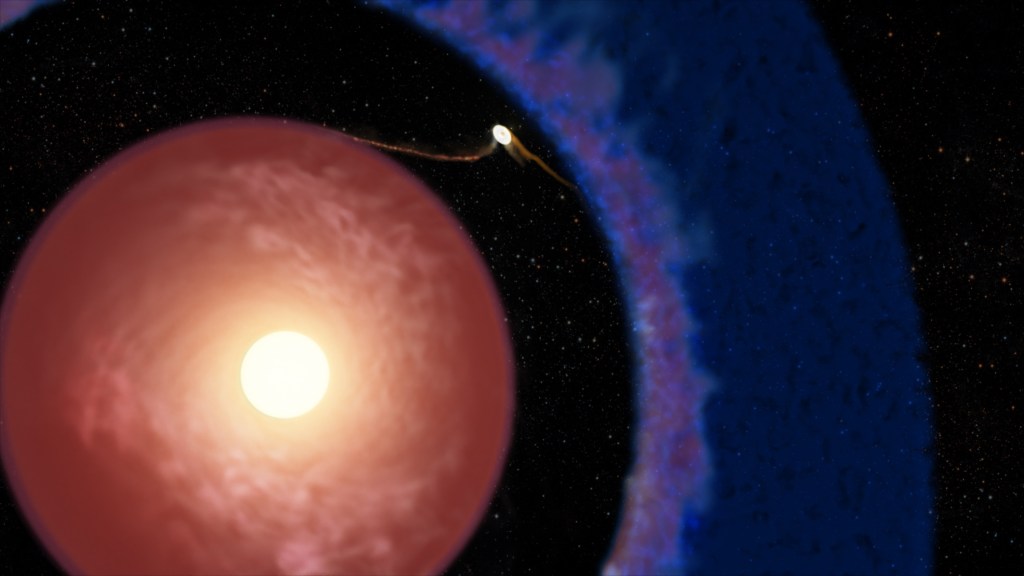
What was found
“Astronomers have confirmed a world that’s less than a million years old as the youngest known planet, using data from NASA-funded archives,” NASA Science reported on 16 September 2026. The world is Elias 2-24 b, and it has not finished forming: it is still inside the disk of gas and dust that made it.
The confirmation comes from a study published the same day in The Astrophysical Journal Letters, led by Andrea Bernardi, a doctoral candidate at the Universidad Diego Portales in Chile. The paper states the stakes plainly: “Since Elias 2-24 b (age ≲1 Myr) is the youngest exoplanet discovered to date, its confirmation has important implications for planet formation timescales and the origin of the gaps observed in very young disks.”
The numbers, each with its source. NASA puts the planet at “about as massive as Jupiter,” and the star “about 450 light-years from Earth” — roughly 140 parsecs. The paper is tighter on the mass and honest about the spread: comparing the measured brightness against 1-million-year isochrones, the team infers “a mass between 1.9 and 4.0” Jupiter masses. The orbit is wide. Elias 2-24 b, the paper concludes, “demonstrates that giant planets can form through core accretion at separations of ∼50 au within only ∼1 Myr” — roughly ten times Jupiter’s distance from the Sun.
The star is not a sun-like neighbour but a newborn. Elias 2-24 is a K5 star, a heavily accreting T Tauri object of about one solar mass with an estimated age of just 0.4 million years, and it hosts one of the largest and brightest protoplanetary disks in the Ophiuchus Molecular Cloud (Cieza et al. 2017). That same ALMA study mapped three concentric gaps in the disk — at 20 ± 3, 52 ± 2 and 87 ± 3 au — and estimated that a planet of 1.0 to 8.0 Jupiter masses could account for the middle one. A separation near 50 au puts the new planet in exactly that gap; the paper is titled “Confirmation of a Core-accretion Planet in the Narrow Gap of the Elias 2-24 Disk.”
Why “youngest” matters
Rings and gaps are everywhere in the disks ALMA images, and for a decade the open question has been what carves them. Cieza’s 2017 paper laid out the candidates for Elias 2-24 itself — condensation fronts (the disk temperature at those three gaps lands suspiciously close to the CO and N₂ snow lines) or dynamical clearing by planets that had already formed — and concluded that telling them apart “might require … the direct detection of planets within the gaps.” That is what this result supplies for one gap in one disk.
The timescale is the sharp end of it. A gas giant of a few Jupiter masses, sitting 50 au out, around a star younger than a million years, is a demanding thing to build: core accretion has to assemble a solid core and then capture an envelope, far from the star, before the disk’s gas is gone. NASA’s caption for the artist’s concept notes that material “is actively accreting onto the Jupiter-mass planet, which sits within a prominent gap in the disk, supporting the leading theory of giant planet formation.” Lucas Cieza — a professor at the Instituto de Estudios Astrofísicos in Chile and a co-author of the paper — put what that costs the models in one line: “Elias 2-24 b shows us that even our best planet-formation models are still missing some important processes.”
How it was found
Not in one night, and not with new telescope time. The instrument is the vortex coronagraph on NIRC2 at Keck II, which masks the star so faint companions survive within about 0.1 arcseconds of it, working in the L′ band at 3.8 microns — the wavelength where a warm young planet stands out best against its star. A 2024 survey with that same instrument looked at 43 disks with resolved millimetre substructure and reported no new point sources at all (Wallack et al. 2024), which is a fair measure of how hard these detections are.
The new paper presents high-contrast imaging of seven stars taken with the Keck/NIRC2 vortex coronagraph in May and June 2018. What turned a point of light into a planet was the archive. Bernardi’s team, NASA writes, “searched the Keck Observatory Archive, a NASA-funded partnership between Keck Observatory and the NASA Exoplanet Science Institute at Caltech/IPAC, for the same little point of light again and found it in observations from 2018 and 2020.” Then: “They stitched the observations together to analyze its motion over time and found that it behaved more like a planet than an imaging defect or background star.” A background star would have been left behind as Elias 2-24 drifted; this point of light travelled with it.
It had been suspected. A protoplanet candidate in the Elias 2-24 gap was already on record: Pinte et al. (2023) found perturbed gas kinematics and local heating in the ALMA CO data at the candidate’s position, and Carvalho et al. (2024) showed the bright ring just outside the gap is a genuine dust trap — the pressure bump a gap-carving planet is expected to leave behind. “The planets should be found within the gaps, since they are carving them,” Bernardi said. “And that’s exactly where we found Elias 2-24 b.”
NASA closes on what comes next, and it is a reminder of how far out this planet is. With the same technique, it notes, the Nancy Grace Roman Space Telescope’s coronagraph “could find planets in much smaller orbits, including true Jupiter analogs that are currently impossible to see through the glare. Elias 2-24 b is about 10 times farther out from its host star.”
The record it breaks
This is the record outright, not a record confined to one detection method. Cieza named the previous holders in the same NASA feature: “Our planet-formation models already struggled to explain the previous record holders for the youngest known planet — a four-way tie between two planets orbiting the star PDS 70 and two planets orbiting the star WISPIT 2 — which are all more than 5 million years old.” At an age of ≲1 million years, Elias 2-24 b is more than five times younger than any of those four.
A separate record survives that comparison. IRAS 04125+2902 b is still the youngest planet found by transit — the dominant method of planet detection, watching a star dim by a fraction of a percent as a planet crosses in front of it. NASA’s 2024 discovery alert called it “really just a baby: only 3 million years old” and “the youngest planet so far discovered using the dominant method of planet detection.” NASA’s exoplanet catalog lists that world as a gas giant around a K-type star, 0.254 Jupiter masses, on an 8.8-day orbit — detectable at all only because its outer debris disk “has been sharply warped,” tipping the system into a geometry where a transit is visible from Earth.
The two detections have almost nothing in common. A transit needs a near-perfect alignment and a tight orbit, and it measures the planet by the shadow it casts; around a young star it also has to fight starspots and the disk itself. Direct imaging needs neither alignment nor a short period — it needs contrast. It sees the planet’s own infrared glow, which is exactly why very young planets are the easiest ones to image: they are still hot from formation, and still accreting. That is the trade. The transit record-holder is a smaller planet measured precisely on a days-long orbit, itself roughly three times older than Elias 2-24 b; the new record-holder is a self-luminous giant 50 au out rather than on an 8.8-day orbit, caught in the act of building itself.
Where it is — and what WatchSat actually tracks
Elias 2-24 lies in the Ophiuchus Molecular Cloud, the nearby star-forming region in the constellation Ophiuchus, about 450 light-years away. None of it is a naked-eye target: the star is a deeply embedded young stellar object seen through the dust of its own birth cloud, and the planet has only ever appeared as a faint point of infrared light beside it in a coronagraph frame on a 10-metre telescope.
So this page is context, not a tracking target — and that is worth saying plainly. WatchSat tracks two kinds of object, both of them inside our own solar system: roughly 16,000 active Earth satellites, propagated live from public orbital elements on the live globe, and the spacecraft humanity has sent beyond Earth orbit. If this discovery is the sort of thing you came for, the closest WatchSat gets is real: Deep Space follows Voyager 1 and 2 and the rest of the outbound fleet from NASA/JPL Horizons ephemerides, and Solar System puts every planet on its real orbit in one heliocentric frame. Elias 2-24 b is roughly 170,000 times further away than Voyager 1 is today — a useful sense of the gap between the systems we visit and the ones we can only image.
Sources
- NASA Science — “Newfound ‘Baby’ Planet Smashes Record for Youngest Known World” (Ashley Balzer, 16 September 2026)
- A. Bernardi et al., “Confirmation of a Core-accretion Planet in the Narrow Gap of the Elias 2-24 Disk” — The Astrophysical Journal Letters, September 2026 (doi:10.3847/2041-8213/ae9bb6)
- L. A. Cieza et al., “ALMA observations of Elias 2-24: a protoplanetary disk with multiple gaps in the Ophiuchus Molecular Cloud” — ApJ Letters 851, L23 (2017) — the host star and the three disk gaps
- N. L. Wallack et al., “A Survey of Protoplanetary Disks Using the Keck/NIRC2 Vortex Coronagraph” — AJ 168, 78 (2024) — the instrument and the 43-disk survey
- C. Pinte et al., “Kinematic and thermal signatures of the directly imaged protoplanet candidate around Elias 2-24” (2023) and C. Carvalho et al., “A Dust-Trapping Ring in the Planet-Hosting Disk of Elias 2-24” (2024) — the earlier evidence for a planet in that gap
- NASA Science — “Discovery Alert: A Rare Glimpse of a Newborn Planet” and NASA’s catalog entry for IRAS 04125+2902 b — the previous record holder
Keep reading
- Deep Space — Voyager 1 and 2 live, with real distance and one-way signal time.
- Solar System — every planet’s real orbit in one frame.
Home · Live satellite tracker · Satellite directory · Starlink · OneWeb · Navigation satellites · Space stations · Other active satellites · Track the ISS · ISS visible passes · Starlink train · Rocket launches · Aurora forecast · Humans in space · Solar System · Deep Space · Guide: spot the ISS · Guide: what is a TLE? · Guide: how many satellites? · Discovery: Elias 2-24 b · About · FAQ · Data & methodology · Credits · Contact · Privacy · Terms